
Friday, October 2


Tuesday, June 26

Wednesday, March 28

Friday, February 17

Wednesday, November 30

Monday, May 23
Seminar - Transformative e-Learning in Higher Education

OVERVIEW
This seminar brings together five experts in education and e-learning to share their ideas, experiences and best practices on how we can use e-learning to transform the way we learn and teach in higher education. They will explore a variety of areas essential to construct transformative learning experiences covering instructional design, online facilitation and assessment, personal learning environments, and e-learning quality and governance.
Date: 5 July, 2011 (Tuesday)
Time: 8.30 am – 5.15 pm
Venue: IMU Bukit Jalil, Kuala Lumpur, Malaysia
SPEAKERS
- Prof Dato’ Dr Ansary Ahmed
President / CEO, Asia e University - Assoc Prof David M. Kennedy
Director, Teaching and Learning Centre, Lingnan University - Prof Rozhan M. Idrus
Professor of Open & Distance Learning & Technogogy, USM - Prof Dato’ Dr Jai Mohan
Director, Learning Resources, International Medical University - Zaid Ali Alsagoff
E-Learning Manager, International Medical University
KEY TOPICS
- Instructional Design
- Personal Learning Environments
- Curriculum Design & Management
- E-Learning Quality & Governance
LEARNING OBJECTIVES
At the end of this seminar, you will be able to:
- Apply effective instructional design principles to your learning environments.
- Adopt effective online facilitation and assessment strategies to engage and assess your learners.
- Build your personal learning environments using social media and web 2.0 tools.
- Identify and discuss essential e-learning quality and governance issues.
TARGET AUDIENCE
- Academics
- E-Learning Professionals
- IT Professionals
- Instructional Designers
Registration Fee: RM650
Early Bird Registration: RM500
(Before 8 June)
If you are interested to attend, please download this form. It includes all the registration and contact details required to attend.
Looking forward to your participation!
Friday, April 29
Insightful Videos Exploring Why the Finnish Education System Rocks!
![[Finland+pisa.JPG]](https://blogger.googleusercontent.com/img/b/R29vZ2xl/AVvXsEh1uYrOELtn_LjxBQSS9F7rDfF6Yj4OHjGq6A7xpD9LNjLECyQJU5AjaECRs-Kyx5ahBllfstNtK3NxsvUT9p-_o4HyuliW1_3JrywyIM-u2ScaETWdima-H6uKL_-Ji2BMy9ttigR4T5o/s1600/Finland+pisa.JPG)
“Education is the most powerful weapon which you can use to change the world.”
- Nelson Mandela
Professor Thomas Baker wrote an insightful blog post recently about why the Finnish education system rocks, and included 5 YouTube videos sharing more insights and secrets behind their success.
I did share some secrets about the Finnish education system way back in 2009, and although I have discovered more interesting things about this awesome learning ecosystem, I am going to refrain from spilling it out here, and have decided to dedicate this post to harvest a juicy collection of videos providing more authentic insights.
This collection will hopefully be useful for you (and me), as the craze around the world to discover the Finnish education system is increasingly becoming a (wrestle) mania.
Finally, I will be adding new insightful videos about the Finnish education system as I discover them, and please share insightful videos that I might have missed out. In other words, don't hesitate to revisit this post :)
THE FINNISH EDUCATION SYSTEM (VIDEO COLLECTION)
Here we go:
Watch the full episode. See more Need To Know.
More insightful videos?
- Ingredients of the World's Best Education System, Pasi Sahlberg (22 min)
- The Politics of Finnish Education (Jukka Sarjala, chairman Finnish National Board of Education)
- Finland's Ambassador Lintu - Why Finland Schools Succeed (35 sec)
- Teachers Key to Finland Education Success (32 sec)
- Who's No.1 in Education? (11 min)
- Schools in Finland (8 min)
If you have any other videos about why the Finnish education system rocks, please don't hesitate to share them (in the comments section)...will add them above. Thanks!
All (Finnish education insights)-in-one post :)
Friday, April 22
E-Learning Trends and Challenges in Malaysian Higher Education Institutions

- Datuk Seri Mohd Khaled Nordin (Minister for Higher Education)
Last Saturday (16th April, 2011), I attended the "Majlis Pelancaran Dasar e-Pembelajaran Negara (DePAN), Buku-Buku e-Pembelajaran dan Malaysia Education Online (MEdO)" event launched by Datuk Seri Mohd Khaled Nordin (Minister for Higher Education).
It turned out to be a very exciting and enriching learning experience for me, and here are my discoveries and reflections...
MALAYSIA EDUCATION ONLINE (MEdO)
The MEdO platform itself is based on a fusion of Joomla and Moodle with some customization to suit its needs and requirements. As many universities are already using Moodle, it could speed up the learning curve (familiar environment) and adoption by educators that will be required to use it.
It will be interesting to see how this project unfolds. Let's be positive about it :)
E-BOOKS
Besides MEdO, the National E-Learning Policy (Dasar e-Pembelajaran Negara) for Higher Education Institutions, and two books (and one translation) about e-Learning in Malaysian Higher Education were launched.
Here we go:
- National E-Learning Policy for Higher Education Institutions
(will add the link when made available) - e-Pembelajaran di IPTA Malaysia (Issuu version)
This e-book provides great insights into how especially public Universities in Malaysia are using e-learning to facilitate learning and teaching. It includes 20 University papers sharing their e-learning stories. - Amalan, Keberkesanan & Cabaran Pelaksanaan e-Pembelajaran di IPT Malaysia (Issuu version)
The English version is below... - e-Learning in Malaysian Higher Education Institutions: Status, Trends & Challenges (Issuu version)
Will be discussed next...
E-LEARNING IN MALAYSIAN HIGHER EDUCATION INSTITUTIONS
I have to admit I was thrilled to discover the e-Learning in Malaysian Higher Education Institutions: Status, Trends & Challenges publication during the event. Actually, I couldn't wait and was reading it furiously during Datuk Seri Mohd Khaled Nordin's speech (please don't tell!), and what struck me most was all the juicy statistics (Yes, I just love that!) about what was going on in Higher Education in Malaysia, and the simple language used to describe the survey results and findings.
Also, the three (3) questionnaires (E-Learning Admin, Lecturer and student) used for this research were comprehensive and easy to understand (Check Appendices/page 123). The findings in the book is based on 7,962 survey respondents (26 e-Learning administrators, 1,635 lecturers and 6,301 students) from a sample of 30 Malaysian Higher Education Institutions (HEIs), comprising of 20 public HEIs, 7 private HEIs, and 3 polytechnics. As four (out of 7) e-Learning Admins from the private Universities did not participate, I suppose we could generalize that the findings mostly represent what is going on in the public HEIs in Malaysia.
Before I dwell more, I would like to introduce you to Prof Dr Mohamed Amin Embi, who was the chief editor for all the three books mentioned above. He was also the first recipient of the prestigious National Academic Award 2006, and the recipient of the distinguished ISESCO Science Laureate 2010. In other words, he is a pretty interesting guy to know. So, next time you want to know more about e-Learning in Malaysian HEIs, who are you going to call? Simple answer: Prof Dr Mohamed Amin Embi
Yes, he has also summarized nicely the key findings of each chapter in the book, and then published them on SlideShare. So, instead of summarizing the book, I can focus next on providing some of my own insights and reflections to what has been published.
Let's rumble...
Chapter 2: e-Learning Policy
- Do we need to have e-learning policies to make e-learning work for us?
- Who should be involved in formulating e-learning policies (all stakeholders, including students)?
- How detailed should e-learning policies be (any template)?
- Can e-learning policies have a negative impact on implementing e-learning?
- Should the Ministry of Higher Education (MOHE) have a mechanism to enforce all HEIs to have e-learning policies?
So, e-learning policies is something that all HEIs should explore, but we have to be careful, and strive to find the right balance so that they empower people to learn and innovate, instead of becoming an obstacle to moving forward.
Chapter 3: e-Learning Governance
According to the survey results, the two main challenges related to the e-Learning governance are shortage of staff (84.5%) and lack of incentives provided by the HEIs to those responsible for implementing e-Learning (69.2%).
So, no doubt HEIs need to invest more in quality staff, and be creative about providing incentives (e.g. less administration and more time to think!) that inspire educators to take the effort to transform their own learning and teaching. It is strange that institutions can spend millions and millions on hardware, networks and software, but when it comes to investing in quality people and paying competitive salaries with the industry; It is so difficult!
In short, HEIs need to rethink their hiring and salary policies to capture the great talent that is out there, but are very reluctant to work in HEIs. Also, HEIs need to learn from creative companies like Google, Apple and Zappos on how to build working environments that empowers and inspires people to express their potential. Challenging, but certainly possible :)
Chapter 4: Learning Managements Systems
Though, from a learning point-of-view, we need to increasingly look beyond the LMS (they just cannot keep up with disruptive innovations taking place), as increasingly learning will take place outside in the web 2.0 (3.0/x.0) and social media worlds in the form of personal learning environments tailored to what learners and educators really want. Here is a crash course:
Chapter 5: e-Learning Training
Sadly, only one-third (34.6%) of the HEIs provide exposure to Web 2.0 applications. Though, I foresee a huge growth in the coming years of educators using Social media and web 2.0 (3.0 and x.0) beyond the LMS to facilitate more engaging and relevant learning with their students.
It will also be interesting to see how institutions deal with copyright and privacy issues, when educators and students increasingly use tools such as Facebook, Twitter, Blogs, YouTube, Wikis, etc.
Are you prepared for that? Don't wait! It is happening already!
Chapter 6: e-Content Development
One word: Ouch! Hopefully, Apple will come to its senses and allow Flash to run smoothly on an iPad, iPod or iPhone. Unless Steve Jobs retires soon that might take some time. Though, let's hope that browsers will have auto-converters, or that Flash is updated to meet all Steve Jobs requirements, otherwise e-content developed in Flash would be useless on Apple-based mobile devices. Luckily, Flash-based content works on Androids :)
The five major challenges faced by most HEIs are lack of motivation among the academic staff (65.4%), lack of specialists (53.80%), lack of a dedicated team to develop e-Content (53.8%), lack of commitment among academic staff (46.2%), and lack of funding/budget (46.2%).
Why are not academic staff motivated or committed to develop e-content? If you are already overloaded with administration, research, publication and teaching obligations, you are not going to be inspired to develop e-content for your students without some seriously good reasons.
Incentives could help (e.g. one e-content module = 1 publication in a high impact journal), but you still need to find the time. In Chapter 10 (page 119), it is proposed that common university courses could be developed jointly by a centre under the Ministry of Higher Education, as this is a more efficient use of resources, time, money, and manpower, while maintaining an acceptable level of quality.
In a nutshell, we could establish Malaysia's first official ‘Open Courseware’ initiative, which would enable all HEIs to have access and reuse (hopefully remix) freely common University courses. By doing so, then HEIs can streamline their resources to build unique e-content for their unique courses.
Based on the survey, the copyright issue is also a big problem faced by the majority (80.8%) of Malaysian HEIs in the development of e-Content. What to do? Forget Copyright, Practice Copyleft Instead!
Actually, we need to rethink our obsession with e-content development, and be more obsessed with designing relevant and engaging learning environments/spaces, where authentic learning activities play a larger role than (spoon-feeding) e-content and courseware.
Instead, HEIs students should be empowered and nurtured with the necessary learning skills to find their own content based on the learning outcomes set, or we could expose them to a variety learning resources (for each topic) and then require them to analyze, evaluate, synthesize, and then create their own contextualized meaning.
We want to develop independent lifelong learners. The e-content or courseware (spoon-feeding) model is an easy shortcut to enable them to pass the exam, but perhaps not the best way to nurture the necessary skills required for them to thrive in the 21st century.
Finally, educators need to learn the art of aggregating, filtering and remixing content from a variety of resources using a variety of learning tools out there. In a nutshell, think beyond e-content development, and focus more on nurturing educators to build sizzling learning activities and spaces for students.
In short, only develop e-content when it does not exist, or it can be synthesized or presented in a more engaging and meaningful way :)
Chapter 7: Integration of e-Learning in Teaching & Learning
According to the survey findings, lecturers' two major challenges to integrate e-Learning in their teaching and learning, is trying to balance between teaching and research (59.8%) and time constraints (54.9%). Interestingly, technophobia (13%) was the least responsible challenge among the challenges faced by lecturers in order to integrate e-Learning.
For students, the two major challenges is lack of access (53.4%), and feedback from lecturers takes too long (42.8%). By focusing less on developing e-content, lecturers will have more time to interact with their students, and construct more interactive and engaging learning environments. If we can be replaced by a courseware, then we should be replaced.
To no surprise, most lecturers (50.1%) prefer to upload materials on a weekly basis before the classes begin. Noteworthy, most students (84.7%) prefer to read the materials offline rather than online. The challenge comes when students have printed out the uploaded slides before their class (often weeks in advance), and then find out during the lecture that the slides have been updated. What do you do? Establish an e-learning policy forcing them to upload their slides at least one week before...Not a good idea! Call me to elaborate :)
On a positive note, this is a problem of today, and probably won't even exist in 3-5 years' time. Why? By then most students will be reflecting their slides on their mobile devices in the form of iPads, Kindles, Galaxy, etc.
Chapter 8: Quality Assurance
How do we ensure that our e-learning implementations are of quality? How do we ensure that our conventional learning approaches are of quality? Do we look at the drop-out rates? Or perhaps the students satisfaction levels? What about using the students' assessment results as a measure of success?
On page 119, the guidelines on e-Content standards that were developed collaboratively by CEMCA (Commonwealth of Educational Media Centre for Asia) and MOHE is recommended to be distributed and followed by all Malaysian HEIs in order to control the quality of e-Learning materials available at the tertiary level.
I disagree in using these guidelines as the standards, but it could be used as a good reference guide, like so many other guidelines out there. Personally, I don't even like the expression 'Best Practices', but instead prefer 'Good Practices'. The reason is that there is simply too much innovation and exploration still needed to be done, before we can settle down with any form of standards in E-Learning. Let's celebrate 'Good Practices' out there, and learn from them to create our own contextualized 'Good Practices'.
We want standards, but standards are often the biggest enemy to creativity and innovation. Let's not forget that!
THE FUTURE?
Not surprisingly implementing mobile learning is a priority (92.3%), according to the survey findings. Interestingly, lecturers (67%) and students (76.8%) believe that HEIs should give priority to Intelligent Tutoring Systems as compared to other applications.
Strangely enough, lecturers (23.4%) and students (19.4%) place podcasting applications as the lowest in terms of priority. Maybe it is just me, but I would prefer listening and reflecting to a great lecture over a courseware anytime of the day, no matter how interactive it may be. I suppose I am a bit weird!
If you don't have time to read the whole book, just read chapter 9 (summary) and 10 (recommendations), which will provide sufficient insights to see the big picture. Though, I would strongly recommend to enjoy all the diagrams, charts and stats spread over 120 pages.
So, what can we expect next?
Based on the suggestions given in the book (page 120), MOHE will probably soon establish 'The National Institute of e-Learning', a centre of excellence for e-Learning, that can conduct and coordinate research on e-Learning, particularly in terms of the impact of e-Learning on student achievement.
Let's hope the National Institute of e-Learning becomes an inspiring light that empowers and sparks sizzling e-learning at all HEIs.
Will I be involved?
Only God knows at this moment :)
Thursday, April 7
Baby Salma Uses iPhone to Learn 'Apple'!
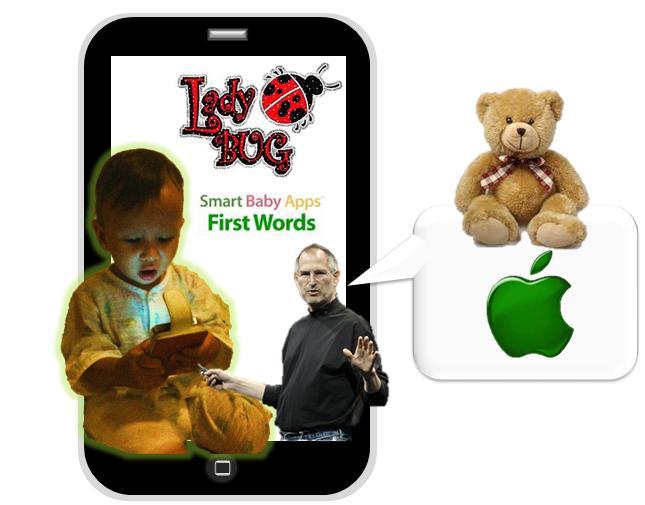
I suppose a 36 second video clip would make more sense now:
In the video clip above, my wife is teaching baby Salma new words using voice narrated Flashcards. The cool thing about apps like My First Words, is that you can also record your own voice, and even create your own Flashcards. Cool!
If you notice, baby Salma is not satisfied by simply watching passively my wife clicking the 'NEXT' button. Instead, she wants to grab the iPhone (Ownership), so that she can hold it and play with it herself. We all know what happens, when babies don't get what they want. However, what about students?
In other words, when we teach or facilitate learning, we should perhaps provide more opportunities for students to explore learning, and take ownership of their own learning process, which is often more inspiring than being told what to do for 15 weeks per semester.
99.999% of us love to learn, but how many of us like to be taught? Or have you ever been inspired to learn by following instructions?
Think about it!
LADYBUG
Baby Salma simply loves Frank Leto's 'Ladybug Ladybug' Song, which she sings (and claps her hands) along in her own baby 'GAGA' language.
TED TALK
I skipped iPad 1, as I usually keep away from first versions of anything, but I will probably invest in iPad 2 when it comes to Malaysia (officially!). Based on my kids' (3) obsession to play games with iPhone, I suppose I will only be able to use the iPad for self-learning when they all are asleep!
What do you think? :)
Tuesday, March 15
My #CCK11 Talk - Sharing to Connect, Interact and Learn!

RECORDINGS
For those that want to recap or missed the session, here are the Elluminate and MP3 recordings:

FEEDBACK
Looking back at 2010, one of my goals was to work on my voice to reflect my passion and enthusiasm for learning (enthusiasm is contagious!!!!), and based on this session... Mission Accomplished!
But, what about the talk's substance? Mission 2011!
Although, I am receptive to positive feedback (appreciate that!), I do have my own self-evaluation sensor, which at times can be pretty brutal and unrealistic. Though, this beast is also my secret and most powerful weapon to awesome learning, so I am not going to let it go. Instead, I will celebrate it with a receptive and reflective laugh!
REFLECTION
But thank GOD I managed to somehow get through without too many bloopers and mistakes! Though, after listening back to my talk (MP3), I realize I said 'Amazing', an amazing amount of times (too vain to count).
Also, my voice was stumbling more than usual ('Hm-ha'), which could be due to the fact that it was my first Elluminate session with my new MacBook Air (CTRL Vs Command! Touchpad!), or perhaps my limited brain power was just running out of fuel. Or could it be that especially the first part of my talk (Openness in Education), I explored areas that was not exactly my specialty, except for finding great learning resources. But then again, I always like to challenge myself, and felt that I wanted to cover it, as it was inline with the theme of the week (Openness & Transparency).
Moreover, I had problems following smoothly the lively chat-board discussion while giving the talk (produced 3000+ words during the 1-hour session). But that is something I can easily improve with a bit of practice.
In addition, I did mess up names as usual. For example, I said Stephen Downes when referring to George Siemens (on slide 31), in reference to the 'Open Education Open Debate' resource'. I suppose that is why I would be a really bad MC!
Finally, I believe the 3 reflection scribbles on the Elluminate whiteboard (Openness in Education? Why share? Moodle wish?) was something the participants collaboratively enjoyed. Some participants even found time to scribble on the slides, especially Stephen and Wiley's faces when they occurred. I believe Stephen was the ultimate scribbler (No evidence to prove it, unless he admits), and no doubt he has artistic ability that needs to be nourished.
Overall, I have no complaints, and the participants were absolutely fantastic. Also, George and Stephen didn't give me a hard time at all, which could be due to the fact that our views on openness in education are not so different. Yeah, I did praise and promote them a bit, and that surely didn't hurt their connective egos either.
It was a great learning experience and adventure that is now completed (history!), and I am truly grateful to George and Stephen for giving me this opportunity.
Thanks :)

Wednesday, March 9
Kable.MY - Malaysia's Premiere Instructional Technology Website

NEW!
19 hours ago, I got a pleasant e-mail from Hafiz Hanif, who invited me to visit his new Kable.MY website. I was also invited to be a freelance writer for the website, but I told him instead of being a freelance writer, why not use whatever you like from ZaidLearn, and then link back to the original post (article). The reason is that whatever I write to share (to anyone), I will post it on ZaidLearn (First!). Anyway, this post is not about ZaidLearn, but about this awesome Kable.MY website that I just discovered, thanks to Hafiz Hanif.
Although, Kable.MY is still brand new, and probably needs some time to build up a substantial collection of awesome articles (unless they reuse with attribution and permission from great Edubloggers out there), I am really impressed with the website design, and the first few articles too are very useful and relevant.
INSPIRING!
Also, I like their team's learning philosophy and spirit:
"We are a bunch of normal educators like you, with the enthusiasm to provide the latest and fun ways to teach students, to inspire them with the use of technologies that are often regarded as a separate entity from our instructional strategies. Here, we share our thoughts on how to integrate technologies into your everyday teaching and learning activities, and how to understand the design of certain applications, how to re-purpose the applications to suit our educational needs, and how to get control over our own methodological strategies (Source)."
Yes, certainly a good start! The challenge is to keep that volcanic creative eruption continuously flowing, and if the passion and focus is there... WOW, this could evolve into something really special!
Thinking of it, after being inspired by Kable.MY's awesome website design, I believe it is time to relook and rethink the website design of ZaidLearn, which has not really changed much since its inception. But then again, neither has Google's homepage either. But, then again I have yet to find that swoosh factor that fits ZaidLearn's flavor and content. One thing for sure, I would want the revamped website to infuse a lot of (white) dreaming space free from anything.
I believe it is time to erupt some changes soon...Need another 102 days to think about it!
Kable.MY, thanks for this inspiring website, and hopefully it will inspire more educators in Malaysia to share their learning stories and tips. Yes, why not :)
Thursday, February 24
Use Twitter #Hashtags to Amplify Your Learning!

If you are confused about what Twitter hashtags are, you have come to the right place to understand the power and possibilities that these learning conversations can do to amplify your learning!
WHAT ARE HASHTAGS?
Also, please keep in mind that Twitter hashtags can occur anywhere in the tweet, and that they are not case sensitive, as shown in the example below (#cck11 or #CCK11 = No difference):
 Today, Twitter hashtags are widely used for conferences, events, courses, topics, trends, etc. enabling people to easily follow and participate via hashtag learning streams relevant to them.
WHERE DO I FIND JUICY HASHTAGS?
Actually, if you are looking for global (or country) trends you can for starters discover some on your Twitter homepage, which will display the top 10 trends at that particular moment.

If you are looking for (#hashtag) trends, then tools like What the Trend?, Twitterfall and Tagalus should be useful.

Actually, sometimes you can discover enriching hashtags by accident, when reading tweets from people you follow. However, the fastest way (to me) is to Google up educational hashtags and find a gold mine like this one: Educational Hash Tags (Cybrary Man)
Here some interesting learning hashtags that you might want to follow (Save):
- #edchat - Education
- #CCK11 - Connectivism and Connective Knowledge 2010 Course
- #edutech - Educational Technology
- #web20chat - Web 2.0
- #hsc – Homeschooling
- #ecosys – Changes in public education
- #DistEd – Distance education and e-learning
- #innochat – Innovation in education
- #Lrnchat – Learning issues for educators
- #ellchat – English Language Learners
- More... :)
HOW DO I FOLLOW (SAVE) A HASHTAG?
There are several ways, but if you want to simply follow (save) a juicy hashtag from Twitter itself, you can first:
- Copy/Paste the hashtag into Twitter Search (Or simply click the hashtag on your Twitter page) and then Search.
- Then click 'Save this Search'
- Click 'Home'
- Select the hashtag from your 'Searches'... Done!

However, many today hardly spend time on the Twitter homepage itself, and prefer using their mobile devices and tools like TweetDeck to check Twitter updates regularly (every 3o seconds!).
In addition, some prefer real-time updates on tweets and hashtags (a flowing learning stream), and tools like Monitter, TweetGrid and TweetChat are awesome for exactly that. For example, you might want real-time Twitter updates during an event, or learning session on a big screen (or projector), meaning you can reflect and discuss on the spot issues streaming down the screen (no refreshing needed!).


If you find your Twitter homepage messy for having conversations, you could try Twitoaster, which threads and archives your conversations in real time. This tool could help you improve the way you communicate with your students or connections (followers).

HOW DO I CREATE A HASHTAG?


Join the #moodlewish Twitter Stream!
Other excellent resources that explore Twitter hashtags:
- Hashtags
- HOW TO: Get the Most Out of Twitter #Hashtags (Ben Parr)
- What Are Hashtags ("#" Symbols)? (Twitter Help Center)
- Twitter users discuss educational issues through Hashtag Chats (Alexis)
- Educational Hash Tags (Cybrary Man)
- Twitter Power: The Twitter Hashtag (Jordan)
- 15 Fascinating Ways to Track Twitter Trends (Ben Parr)
WOW! That wasn't so difficult, was it? :)
Wednesday, February 23
The Linguistic Genius of Babies (Patricia Kuhl)

LINGUISTIC GENIUS OF BABIES
Of course it easier to learn a language when you are younger, especially when you are a baby. What do you do besides eating, playing, exploring, sleeping, crying and ______?
However, I don't agree with the diagram above, because I believe it is much more to it than simply getting stuck in the age thingy about learning a language. No doubt human being's ability to acquire a new language declines with age to some extent, but there are many more factors to learning a language than just the decline of the brain, which could vary dramatically from person to person, depending upon how they use it during their lifetime.
What about interest and passion to learn a language? For example, if a 30 year old dude has the interest and passion to learn a language, I am pretty sure he or she will learn a language much faster than a 3 year old kid, especially if given the same amount of time to achieve it.
Perhaps the brain power has declined, but by using learning and thinking skills acquired fused with passion and interest... No contest!
Well, that is my opinion, and I don't have a Magnetoencephalography (MEG) to prove it. Neither am I a linguist (and I am crappy at learning languages, too!), but I have met passionate people my age, or older that have a gift for learning languages really quickly. So, age might be one factor, but the interest and passion to learn fused with effective learning methods, I am pretty sure we can continue to learn new languages pretty well until we expire :)
What do you think?
Wednesday, January 12
IMU Student Blogging Project to Promote a Healthy Lifestyle!

THE STORY
Of course that made me excited, as I have been promoting the usage of web 2.0 and social media for learning ever since I joined IMU (June 2009). And having already been through one cycle assisting Prof. Khoo Suan Phaik with her students' project using Google Sites, I was quite confident it would be an inspiring and valuable learning experience.
A CRITICAL & REFLECTIVE RESPONSE TO MEDIA
This module facilitated by Sheba DMani focuses on connections between media and health within socio-cultural contexts. Media in the form of text and graphic presented through visual and audio modes from magazines, television and internet will be explored. These may include advertisements, films and music videos related to themes on health and healthcare. Students will approach these media texts through critical interpretation, reflective thinking and creative presentations. Upon completing this course, students will have learned that the media constructs views of the real world and that these views have been mediated to provide filtered and partial meaning of health belief and behaviour.
THE PROJECT & EVALUATION PROCESS
The blogs would be evaluated based on their originality and creativity (title, tag-line, content, etc.), and the blog had to include at least 3 articles/columns and/or editorials that convey messages on the chosen topic. Finally, each blog had to include at least one video or audio message developed by the group.
STUDENT LEARNING OUTPUT?
 "Healthy foods for a healthy baby"
The project team (Amelia, Melisa, Moushini, Natasha, Ray, Shahira, and Sharon) did a great collaborative effort. Congratulations!
In one word: Wonderful!
 "Teenage Life is Never Black & White"
 This blog focuses on adolescent issues aimed at the teenage population of 13-19. It explores in an emotionally creative, but informative way common youth challenges such as alcohol, drugs, relationships (family/friends/girlfriend/boyfriend), stress and smoking.
To really connect with the youth in an inspiring and engaging way, this hard working project team mashed-up their own original graphics, directed and recorded a short Abstinence Educational Video, set up a Facebook page, and used Xtranormal to create this cool animated video:
In one word: AWESOME!
 "BIG or small, We Save them All"
 This blog focuses on Asperger's Syndrome, which is often misunderstood among people. Asperger's Syndrome is an autism spectrum disorder that is characterized by significant difficulties in social interaction, along with restricted and repetitive patterns of behavior and interests. The project team has done a good job in designing and structuring the few (identified), but relevant issues regarding this disability, which include helping people to recognize it, statistics and epidemiology, books and resources, and famous people with it. Did you know that Albert Einstein had Asperger's Syndrome? Now you know!
In one word: INTERESTING!

In one word: CREATIVE!
Though, we still have to work on their fair use or reuse of external content and graphics, and teach them proper online referencing procedures, which is something we have to continue to work on. It is alright to quote and reuse (if permission is given), but we must appreciate and recognize other people's work. As such we have already setup a site for IMU staff and students (only) exploring project based learning (in the e-learning portal), including proper online referencing procedures.
Although, our e-learning portal (using Moodle) is wonderful for uploading and organizing course content, linking online resources, online discussions, assignment submissions, online quizzes, and so on, we should also encourage and empower students to use other web 2.0 and social media tools for creating creative content and informal learning. For example, several lecturers from the School of Pharmacy use Facebook for communicating online with their students, and have experimented with conducting Problem-Based Learning (PBL) sessions using Facebook Groups.
I have noticed that some Universities in Malaysia ban the usage of Facebook and YouTube at their campuses, and use the excuse that they encourage poor learning/working habits and clog up their network (bandwidth) for other usages. That might be true, but if staff and students learn how to discipline themselves using such tools (no choice!), they will actually have access to some of the most amazing learning resources on the planet (for free), and be able to interact with experts and students from all over the world through Facebook groups/pages (e.g. Harvard University - Facebook). I can't think of a better investment for learning than boosting the network (bandwidth) to support online learning in all forms. The Internet is the heart, blood circulation, and oxygen of learning in the 21st century.
More importantly, today more than ever, it is critical to encourage students to nurture their communication, collaboration, creative and analytical skills using the web and multimedia tools. Increasingly in the future, people in organizations will be working and collaborating online using the cloud, so it is important to encourage and necessary to prepare our students for this new world.
Also, it is important to highlight here that the quality of the students' output (results) at this stage is not as important as empowering their passionate and inquiring mindset to explore possibilities and ideas, and continuously reflect, learn and improve from these learning experiences. In short, focus more on the learning process than the output (results). Results will come as they learn. Some are early bloomers, others are late bloomers, and that is something we should never forget.
Can you imagine hiring a graduate that cannot communicate and collaborate online? Try asking that same question in four year's time :)